How Much Does a Croatia Cruise Cost? 2027 Prices, Broken Down by Cabin & Season
A Croatia cruise with Zantium Travel costs from €1,490 per person for seven nights on select (and limited) Season 1 lower-deck departures. Our standard lower-deck options start at €1,890. The fare covers your cabin, breakfast daily, six three-course lunches, two dinners on board, and guided walking tours in four towns.
While it’s true that a high-season Adriatic cruise moves the price upward, the real price differentiator lies elsewhere: your choice of deck (lower, main, upper/sun-deck) and cabin (double, single, or balcony).
Croatia cruise costs you’ll find online run the gamut from a few hundred euros to several thousand per person. That’s because they price different products: a large ship or a small one, a few Croatian ports or a full week on its coast, dinners included or left to you. Our Šibenik–Dubrovnik cruise pricing—with estimated extras—is broken down below.
Croatia Cruise Cost for 2027, by Cabin and Season
In 2027, our lowest price for a cruise in Croatia is €1,490 per person (Season 1, limited lower-deck departures). And it sells out fast. Our standard pricing ranges from €1,890 for a lower-deck cabin in Season 1 to €3,590 for a balcony cabin in Season 3. Single cabins cost €3,190 to €3,790. Every booking covers seven nights, Saturday to Saturday.
CabinSeason 1Season 2Season 3Lower deck€1,890€2,190€2,390Main deck€2,490€2,690€2,890Upper and sun-deck cabins€2,790€2,990€3,190Balcony cabins (upper deck)€3,090€3,390€3,590Single cabin (main deck)€3,190€3,490€3,790
Standard 2027 fares per person, seven nights, Saturday to Saturday. Select Season 1 lower-deck departures from €1,490. Cruise prices vary by ship and departure—booking pages are up-to-date.
The prices are shown in euros, but the booking pages let you switch them to US dollars for an at-a-glance comparison.
Season 1 is home to our lowest fares and Season 3 the highest, but seasons are set departure by departure: in 2027, a late-June week can cost more than one in mid-July. The itineraries show each date’s fare.
SEE SMALL BOAT CRUISE ITINERARIES ›
All Zantium fleet boats take up to 36 passengers, so your stay is genuinely exclusive and far removed from an overpacked large cruise experience. That said, balcony and single cabins are limited—balcony cabins sail on select Dubrovnik and Split departures, and single cabins are on one ship only. If single-cabin privacy or balcony access are a priority for you, check the itineraries below to see which departures include them before you settle on the dates.
What Your Booking Includes, and What You Pay Ashore
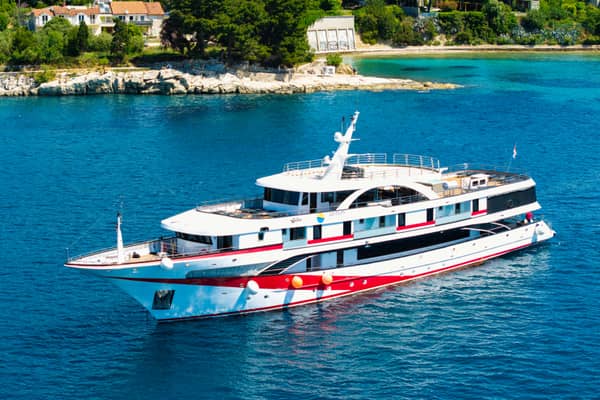
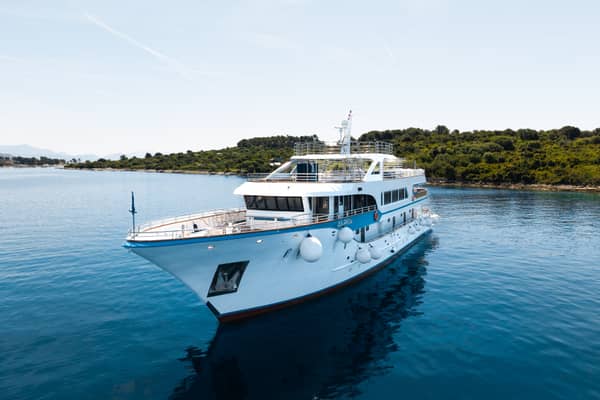
Zantium Alpha – small cruise ship at anchor in a quiet Adriatic bay.
Your cruise fare includes an air-conditioned en-suite cabin, breakfast daily, six three-course lunches, two dinners on board, guided walking tours in Šibenik, Hvar, Korčula, and Dubrovnik, the Ston oyster tasting, the Blue Cave entrance, Wi-Fi, and transfers at each end. Port and residence tax, five dinners ashore, drinks, tips for the crew, Mljet National Park entry, and flights are paid separately.
Included in the fare:
Air-conditioned en-suite cabin, serviced daily
Breakfast every morning and six three-course lunches on board
Two dinners on board: the welcome dinner and the Captain’s Dinner
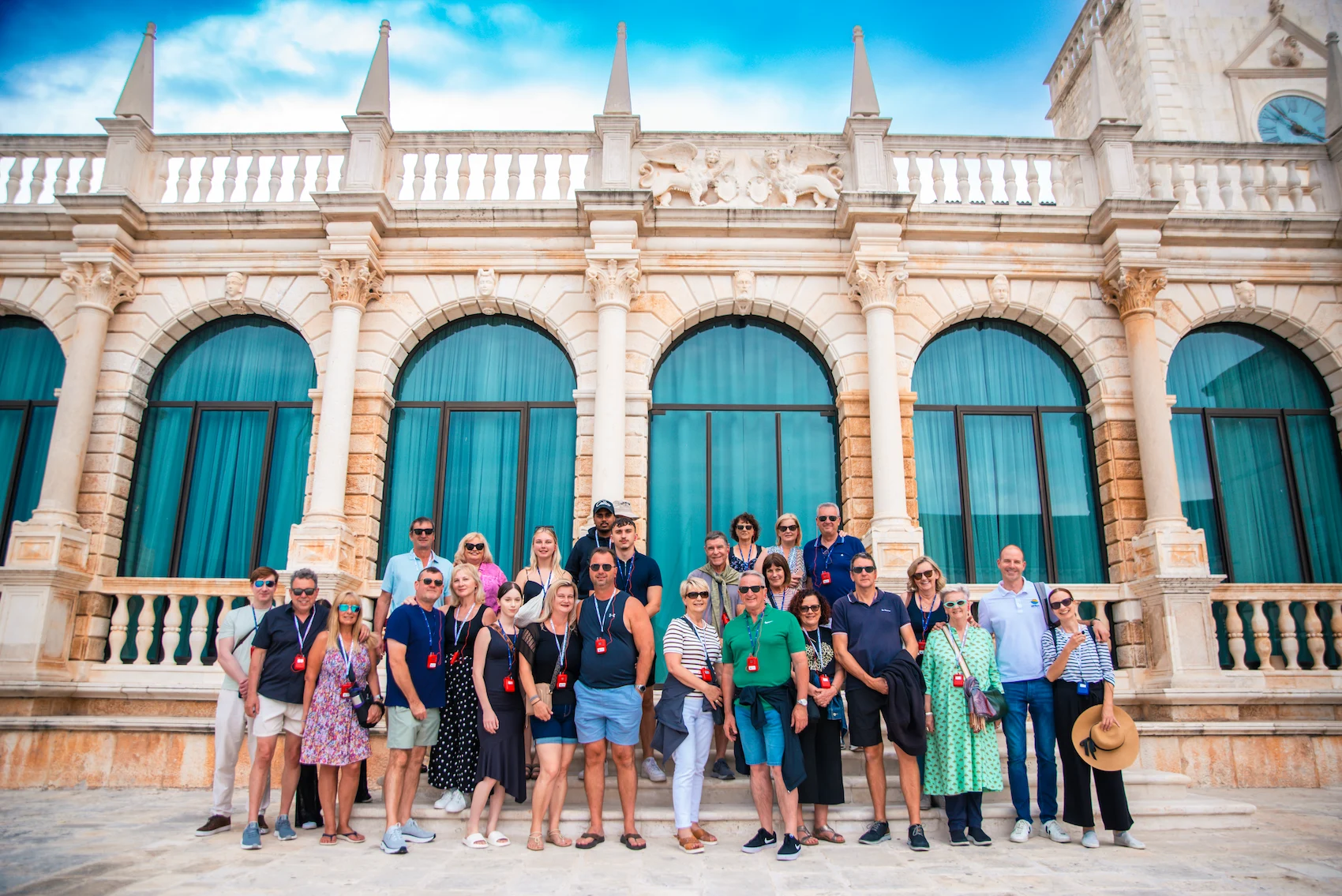
Guided walking tours with local English-speaking guides in Šibenik, Hvar, Korčula, and Dubrovnik (audio sets provided)
The Ston oyster experience: a boat out to the oyster farm, oysters, and wine
Blue Cave entrance (subject to permitting weather conditions)
Swim stops along the way, including Pakleni Islands
Wi-Fi, drinking water, and fresh fruit on board
Transfers on the first and last day, including the airport
Paid separately:
Port and residence tax, €85 per person per week, paid on board
Five dinners ashore (averages out to €175 per person, roughly $200 / £150)
Drinks from the bar, and coffee or tea outside breakfast
Gratuities for the cruise manager and crew (optional)
Mljet National Park entry (€20-30 as of 2026, depending on the month)
Optional shore experiences (April–October), priced on enquiry: Hora Estate, Terra Arhaica, Stella Croatica, and Roki’s Vis
Flights (yours to arrange) and travel insurance (highly recommended)
We confirm current numbers for any departure when you get in touch.
ON BOARD ANTARIS DELUXE BALCONY CRUISE SHIP
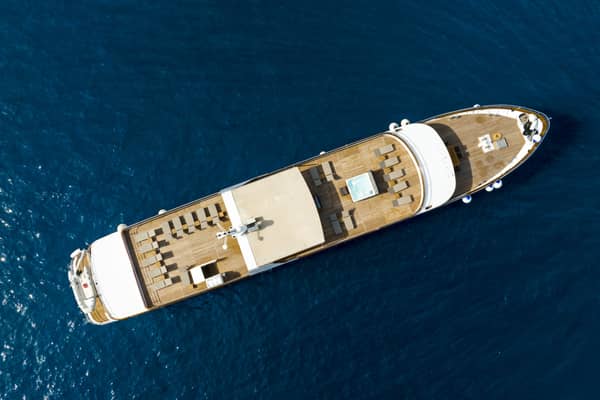
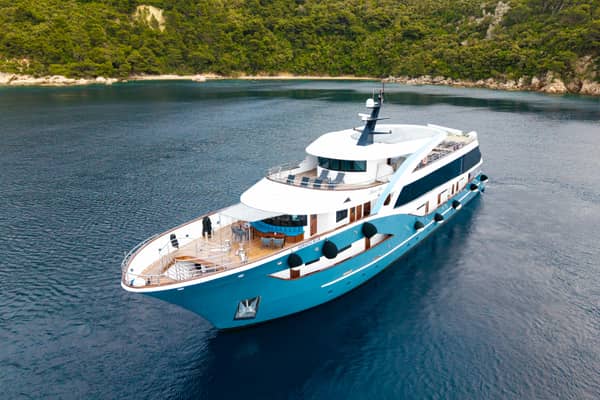
Here’s what your fare buys on one of our ships. Antaris is 51 meters (167 feet) long, with a crew of eight and 19 cabins, each with its own bathroom and 11 with private balconies. On board: a sundeck, a pool, a bar, an outdoor lounge, a restaurant, a swim platform for the swim stops, and free Wi-Fi. In the cabins: air conditioning and heating, a safe, a wardrobe, a TV, toiletries, and a hairdryer.
Sundeck aboard the Zantium Antaris small cruise ship on the Adriatic.
We plan five of the seven dinners ashore, on purpose. On the Vis, Hvar, Korčula, Slano, and Dubrovnik evenings, the town is your dining room: a konoba up a side street, a table on the harbor—you get to experience the best of what that stop has to offer. Most time is free time, and dinner ashore is a big part of it. Your cruise manager will point you to a good restaurant.
The visit to the Blue Cave, on the sail between Vis and Hvar, is something we plan for but can’t guarantee. Its entrance fee is covered, but the visit is the weather’s call—the cave is reached by small boat through an opening about 1.5 meters (5 feet) high, and the opportunity closes with bad weather. In October, closures can be expected, and how often depends on the waves and swell.
What Changes the Price: Cabin Deck First, Season Second
What changes the cruise price most is your cabin’s deck, then the season. On our 2027 cruises, moving from a lower-deck to a main-deck cabin adds €600 per person in the same week, and a balcony cabin adds €1,200. Sailing the same lower-deck cabin in Season 3 instead of Season 1 adds €500.
The usual cost advice for Croatia says the same thing: sail in the shoulder season to save. For our fares, the season matters… but what matters more is the deck.
Take a lower-deck cabin in Season 1 at €1,890. One step up in deck costs more than the whole swing from our lowest season to our highest, and the gap widens as you climb: upper and sun-deck cabins add €900, and a balcony adds €1,200.
The other levers that move the price of our Croatia cruises:
Season. The same cabin rises €400 to €600 from Season 1 to Season 3, depending on the deck.
Traveling alone. Dedicated single cabins start at €3,190 in Season 1. They’re all on one ship, so ask us which departures give you an opportunity to book a single cabin.
Traveling with children. Children under 3 sail free when they share a cabin with two adults. Children aged 3 to 12 pay 30% of the fare in a third bed, or 80% when they share a standard bed with one adult. Third-bed fares depend on availability and apply only in cabins equipped for a third guest.
Booking timing. Earlier bookings get first pick of cabins and rates, which matters most for balcony and single cabins as those are the ones that sell out the fastest. The same is true for triple cabins: most ships have only one or two.
Groups. A full-boat private charter is priced by the ship, from €50,000 for the week. Big families celebrating milestones and groups of friends often take the whole boat and plan their own week, with only the first and last ports fixed. For how large families book, check out our post on family cruises in Croatia.
Croatia Cruise Cost: A Real Seven-Night Example
Aerial view of Šibenik Old Town and the UNESCO-listed St. James Cathedral.
A realistic Croatia cruise cost for two starts at €3,130: €2,980 in fares on a select Season 1 lower-deck departure plus €180 port and residence tax, paid on board. At the standard lower-deck fare it is €3,930. Dinners ashore and daytime drinks add about €455 (roughly $520 / £390) on 2026 averages, and flights come on top.
Here’s a week for two in a lower-deck cabin, split into the cost that’s fixed and the cost that depends on your choice of restaurants and optional extras:
ItemFixed or estimateAmount for twoCruise fareFixed€2,980 on a select Season 1 departure, or €3,780 at the standard lower-deck farePort and residence taxFixed€170, settled on boardFive dinners ashoreEstimateabout €350 (roughly $400 / £300)Daytime drinks ashoreEstimateabout €175 (roughly $200 / £150)Bar tab on boardVariesYour choiceGratuitiesVariesYour choiceOptional shore experiencesVariesOn enquiryFlightsVariesDepends on where you fly fromTravel insuranceVariesDepends on your policy
The two estimates use 2026 restaurant averages for Split and Dubrovnik: about €70 for a mid-range, three-course dinner for two without drinks, and about €25 a day (roughly $29 / £21) for a basket of two coffees plus four beers or soft drinks for the pair.
Those are averages, not ceilings. It’s what most of our guests report—a decent meal for a decent price. That said, a harbor-front table in Hvar or Korčula in high season can come in near the top of the range, more in high-end restaurants.
Bring euros in cash. You’ll need them for two things: the port and residence tax, and the bar tab, which is settled at the end of the week.
How to Compare Croatia Cruise Prices Like for Like
To compare Croatia cruise prices like for like, check five things beyond the headline fare: how many nights you spend along the Croatian coast, how many dinners are included, whether port or residence tax is extra, whether town tours are guided (and included in the price), and how you get from the airport to the ship.
Here’s how the price compares across three ways to spend a week on the Adriatic coast (flight fares are excluded):
Zantium small-ship cruiseLarge cruise shipPrivate crewed yacht (20 m)Price€1,490–€3,790 per personFrom about €1,800 per person (11 nights)€38,000 (low season) to €70,000 (high season) per boat, or €3,800–€7,000 each for tenTime in Croatia7 nightsAbout 2 port days7 nightsPrice includesCabin, most meals, 4 guided tours, local airport transferCabin, mealsBoat, crew, chef, food and fuelBudget extra for€85 tax, 5 dinners ashore, drinksDrinks, most tours, tipsTourist tax, tips
Examples from 2026–2027 prices. Large ship: an 11-night Mediterranean itinerary calling at Split and Dubrovnik. Yacht: a week from Split, low and high season.
Nights along the Croatian coast. Large-line Croatia sailings typically begin outside the country, for example from Ravenna, Rome, Athens, or Barcelona, so check the line’s own itinerary for how many nights you actually spend in Croatia. With us, all seven nights are along the Croatian coast.
Dinners in the fare. Count the dinners a fare includes, then price the rest. With us, two dinners are on board and five are ashore by design, and the example above gives you an estimate for those five.
Port and residence tax. Check whether the headline fare includes it or adds it later. Ours is €85 per person for the week, stated up front and paid on board.
Town tours. Check whether guided tours are included in the fare or sold as extras. Ours include four guided town tours and the Ston oyster tasting.
Airport to ship. Check who gets you from the airport to the ship and back, and at what cost. Ours covers transfers on the first and last day.
If you’re weighing ferries or a bareboat charter instead, our guide to island hopping in Croatia prices those out.
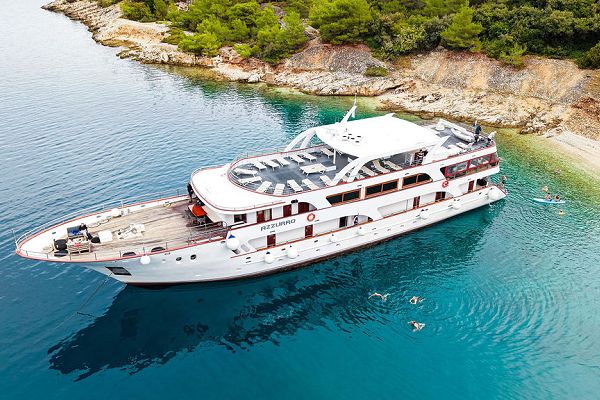
For a reasonable answer about what you’re expected to spend on a Croatian cruise, tally up these five things on the list above. Our small boat cruise along the Croatian coast gives a straight answer to each, on a ship with fewer than forty guests that stays overnight in every port. With a group that size, the week is a cozy affair, and by day three you know everyone’s name.
Croatia Cruise Cost FAQs
How much does a cruise to Croatia cost?
A seven-night small-ship cruise along the Croatian coast costs from €1,490 per person with us on select Season 1 lower-deck departures, and standard 2027 fares range from €1,890 to €3,790 depending on cabin and season. Large-ship Mediterranean cruises that call in Croatia are built differently, so compare nights in Croatia and meals included alongside the headline fare.
How much would a 7 day cruise in Croatia cost?
A seven-night cruise in Croatia with us costs about €1,830 per person on a select Season 1 lower-deck departure, or about €2,230 at the standard lower-deck fare, once the fare, the €85 port and residence tax, five dinners ashore, and daytime drinks are counted on 2026 averages. Flights, gratuities, the bar tab, and optional shore experiences come on top.
What is the best time of year to cruise Croatia?
The best time of year to cruise Croatia depends on whether the lowest fare or a particular week matters more to you. Our 2027 fares are lowest on Season 1 departures and highest on Season 3, and in any week a weather-dependent stop such as the Blue Cave can close in high waves.
Which cruise line is best for Croatia?
It depends on how much of the week you want to spend in Croatia. Large ships usually call at a few Croatian ports on itineraries that also visit other countries, while a small ship like ours spends all seven nights along the Croatian coast, stays overnight in each port, and carries fewer than forty guests.
How much does a 7-day sailing trip to Croatia cost?
A 7-day sailing vacation in Croatia is priced either per person or per boat. A small-ship cruise like ours is priced per person, from €1,490 on select Season 1 departures, with most meals and guided tours included. A 30-foot sailing yacht charters for about €2,000–€3,000 a week, plus marinas, fuel, and a skipper if you don’t sail yourself, while a 20 m crewed catamaran for ten costs €38,000–€70,000 a week, depending on the season.
When You’re Ready to Book, Give Us a Shout
The fares above are the 2027 Croatia cruise cost on our ships, broken down by season, deck, and cabin type. When you decide on those three, reach out to us and we’ll get back to you with a full estimate, with current figures for the tax, the shore experiences, and anything else on your list.
SPEAK WITH OUR TEAM ›