
The best places to swim in Croatia are island coves and warm saltwater lakes, and four stand out.
Stiniva (Vis), a pebble cove behind a cliff gate you swim through. The Pakleni Islands (off Hvar), a chain of pine islets with swimming bays in the channels. Mljet's two saltwater lakes, warm and set inside a national park. Zlatni Rat (Brač), a pebble spit that changes shape with the wind.
Every one of these swim spots is 'stunning': the waters are 'crystal-clear' and the views are 'breath-taking'... and that's exactly why we won't be harping on about it in this guide to best swimming in Croatia.
What we will focus on is how you get to each one of them, water access (do you need to pack your water shoes or not), and what to expect when it comes to water temperature and amenities.
Let’s dig in.
Best Swimming Spots in Croatia: The Short Answer
The list below covers some of Dalmatia's most popular swimming spots — beaches, coves, and saltwater lakes. Some of these are impossible to reach by land and your best chance of getting to them is island hopping or booking a Croatian small boat cruise.
| Spot | Island / Area | How You Get in the Water |
| Stiniva | Vis | Anchor outside and swim the gate, or a steep footpath down |
| The Pakleni Islands | off Hvar | Swim stop off the boat, or a taxi boat from Hvar |
| Dubovica | Hvar | Steep footpath from the road, or by boat |
| Zlatni Rat | Bol, Brač | Walk from Bol, or a taxi boat |
| Badija | off Korčula | Taxi boat from Korčula town |
| Sakarun | Dugi Otok | Ferry to the island plus a transfer, or by boat |
| Šunj | Lopud (Elaphiti) | Ferry to Lopud, then walk or golf-cart across |
| Veliko & Malo Jezero | Mljet | Park entrance, then walk or bike to the lakes |
| The Dead Sea | Lokrum | Boat from Dubrovnik, then a short walk |
Croatia's Swim-Worthy Island Coves and Beaches
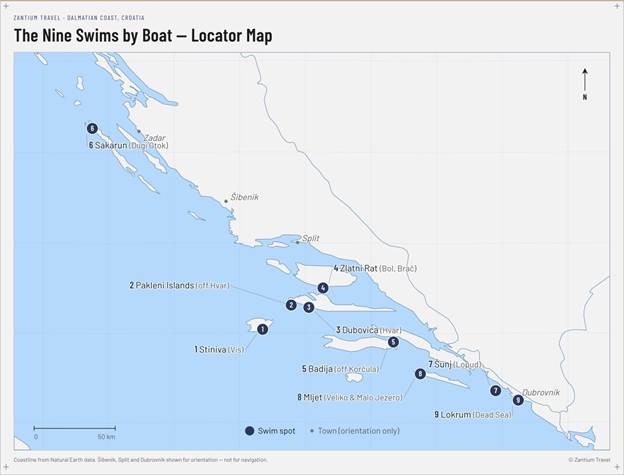
These seven coves and beaches run roughly north to south down the coast from Split. We've visited each and every one several times, from both land and sea, and here's what you need to know about access, what to pack, and the tourist traps to avoid.
Stiniva, Vis
The cove everyone comes to Vis for is on the island's south coast, closed off behind two cliffs that nearly meet. There's no road in. Most people anchor outside the gap and swim the last stretch through it. The only land route is a steep footpath down from the hamlet of Žužec, about twenty minutes on loose stone... but then you have to climb back in the heat.
The small pebble shelf is full of visitors by mid-morning in July and August, and the excursion boats descend on it from late morning on, so come early or come by sea. (The Blue Cave lies just off Vis on Biševo, but you can't swim inside it, so Stiniva is where you actually get in the water.)
Access: Boat, because you have to sail to Vis first. Once you're there, the land route is available but steep — not for the flat-footed, and no shade on the climb back.
Water: A pebble shelf that slopes in gently, then drops off past the cliff gate. Clear enough to read the seabed twenty meters down, and the enclosed, south-facing cove warms fast, into the mid-20s°C (mid-70s°F) through July and August. Sea urchins shelter in the rock slabs near the cliff base, so pack water shoes.
Be aware: From late morning in season the speedboats pack in. There's a rope marking the swimmers' side of the water, but not every skipper respects it, so keep your bearings. One small cabin bar for a cold drink, cash only, and that's the extent of it: no showers, little shade until the afternoon sun drops behind the cliffs.
The Pakleni Islands, off Hvar
This low chain of pine-covered islets lies just across the water from Hvar Town, with swimming bays at Palmižana and in the channels between them. This is one of the Adriatic's most popular swimming spots, and it's where we drop anchor on our run down this coast — the platform goes down off the stern and the water's clear enough to pick out the seabed ten or fifteen meters below.
Here you have to be careful with the timing. Early afternoon is busy — charter boats roam the channels, and excursion ships bring shuttle tourists in droves. The swimming at the Pakleni Islands is best in the early morning, especially in high season.
Access: A short taxi boat from Hvar Town harbor runs across through the season, or your own boat if you have one, which is the only way to reach the quieter bays past Palmižana.
Water: Sheltered and clear, visibility over fifteen meters, with easy depths in the main bays that suit beginners. Summer temperature is in the mid-20s°C (mid-70s°F). The entries are rock and pebble, not sand, and there are urchins on the rocks, so wear water shoes to avoid prickly surprises.
Be aware: Palmižana is developed — beach clubs, sun loungers, and peak-season prices to match — and it fills with boats anchored close to the swimming. If you're snorkeling, stay near the shore and don't cut across the open channel. The boat traffic is the real hazard here.
Dubovica, Hvar
Dubovica, a horseshoe of pale pebbles on Hvar's south shore, is a protected cove opening up under an old stone farmhouse. It's a short drive east of Hvar Town and one of those swimming places in Croatia you'll be glad you made time for. It gets crowded in peak season, but it's still way less crowded than Hvar's staples. If you're on a Croatian island hopping tour and you land on Hvar, carve out an early morning for this beach.
Access: Park on the road above (spaces are informal and fill early) and walk down a steep, unpaved path, about ten minutes down and a longer climb back in the heat. In high summer a water taxi from Hvar Town is the easier way in.
Water: A pebble entry, clear and calm, with rocks along the sides that snorkel well. The bottom is stone, so water shoes are not critical, but you still might want to pack them. Summer temperatures reach the mid-20s°C (mid-70s°F).
Be aware: There's a konoba and a beach bar for lunch and a cold drink, but no loungers to rent and little shade, so bring your own cover. The parking fills by mid-morning in season, as does the beach.
Zlatni Rat, Bol (Brač)
You've seen Zlatni Rat in every photograph of Croatia: the pale pebble spit that runs off Bol and curls at the tip, shifting east or west with the wind. It's the rare famous one you don't need a boat for, and the most crowded swim on this list. Zlatni Rat is best for day-trippers, and if you're going, make sure you're there early morning to catch the loungers and avoid the afternoon NW maestral wind.
Access: A twenty-five-minute walk from Bol along a pine-shaded promenade, or a short taxi boat from the harbor. In peak season a little tourist train takes the same route.
Water: Clear and deeper than it looks, dropping off quickly past the pebbles. The stones are hard on bare feet, so water shoes help. One side of the horn catches the afternoon wind and the other stays calm, so pick your side. Summer runs mid-20s°C (mid-70s°F).
Be aware: Everything here costs money, and not a little: sunbeds, umbrellas, parking, even the showers. By late morning in July and August the beach is wall-to-wall, and afternoon boat traffic is dense.
Badija, off Korčula
Badija is a pine-covered islet a short taxi-boat hop east of Korčula town, with a Franciscan monastery, a colony of tame deer, and pebble coves along the shore path. You reach it on your own from Korčula, where the taxi boats run through the season.
Access: Taxi boats leave from Korčula's east harbor through the season. Check the return times before you go — the afternoon pickups can be limited, and there's no other way back.
Water: Calm and clear, with pebble and rock entries and sea urchins on the stones, so foot protection is a must. The best swimming is a pebble beach a ten-minute walk past the monastery café. Summer temperatures reach the mid-20s°C (mid-70s°F).
Be aware: One café by the monastery, cash only and closing by early evening, and nothing else, so bring water and shade. In high summer the wasps and flies gather around the bins and the food. The deer are tame, but there's a no-feeding sign, so admire them and leave them be.
Sakarun, Dugi Otok
Sakarun is that rare thing in Dalmatia, a genuinely sandy bay, shallow and warm, up toward the northern end of the coast on Dugi Otok. It's well off our route, so this is one for a longer independent trip.
Access: By sea, you can anchor off the beach. By land, it's a ferry to Dugi Otok and a transfer across the island by taxi or bus — a real haul from the southern islands.
Water: Fine sand and shallow water that stays waist-deep a long way out, gentle for children and easy for a float. The sandy bottom means fewer fish for snorkeling. Summer temperatures reach the mid-20s°C (mid-70s°F).
Be aware: This one divides people, so set your expectations. Seagrass washes up and isn't cleared early in the season, the facilities are limited to a couple of seasonal bars and basic toilets, and day boats crowd the bay by midday. Parking is paid, shade is thin, and the payoff is the sand and the shallows, not the amenities. Come early.
Šunj, Lopud (Elaphiti)
Šunj is another sandy one — a wide, shallow bay on car-free Lopud, one of the Elaphiti islands off Dubrovnik. Neighboring Koločep has its own coves and sea caves if you want to pair them and hit two of the best swimming beaches in Croatia in a single day.
Access: Take the ferry from Dubrovnik to Lopud, then cross to Šunj on foot (twenty to thirty minutes, uphill in the sun) or by one of the seasonal golf-cart taxis, since no cars run here.
Water: Fine sand, and water so shallow you wade fifty meters or more before it's deep enough to swim. It's ideal for children... but a slog if you just want to dive in. Clear and warm, mid-20s°C (mid-70s°F) in summer, with a few rocky edges where water shoes help.
Be aware: The beach is small and fills at midday when the ferries and day boats land, so towel space goes fast. There's little natural shade on the sand and the walk over is a sweat in high summer, so bring cover and go early. Beach bars and sunbed rentals run in peak season, and a section at the west end is naturist.
Croatia's Saltwater Lakes
Two of the best swims on this list aren't in the open sea at all. They're saltwater lakes: one set inside a national park, the other on a boat-only island off Dubrovnik.
Veliko & Malo Jezero, Mljet
Mljet's two saltwater lakes, the Big and the Small Lake, hold warm, calm water inside a pine-forest national park. This one is on our route: when we call at Pomena, the park is a short walk or bike from the dock, and the day is yours to swim, ride the shaded loop, and take the park boat to the monastery islet of St. Mary.
Access: Enter at Pomena or Polače and walk or bike to the lakes. Riding up from the ferry port is an uphill haul.
Water: Warmer and calmer than the open sea in summer, clear, with sand-and-pebble entries. Mind the currents at the channels between the lakes.
Be aware: Park entry is paid and (and we don’t include it in our cruise packages), so bring cash or card — € 30.00 as of August, 2206. Current fees and hours are on the park's official site, and you can buy a ticket online as well. The island restaurant is pricey, so pack a lunch.
The Dead Sea, Lokrum
Lokrum, ten minutes by boat off Dubrovnik's Old Port, holds a small saltwater lake the locals call Mrtvo more, the Dead Sea. It's saltier than the open water, so you float without trying. It isn't on our route, but an easy hop on your own.
Access: A boat from the Old Port, then a ten-minute walk through the pines to the lake. It's a paid reserve, and the ticket covers the boat. Prices and boat times are on the reserve's official site.
Water: Calm, warm, and salty enough that floating is effortless. The edges are rock, so water shoes help, and there are anemones that sting, so watch where you settle.
Be aware: Day trips only, and everyone leaves on the last boat in the early evening. The lake is busy by midday, so come early or late, and bring water since the café is limited.
What a Swim Stop Looks Like From a Small Ship
On a small ship, the swim stop isn't a scramble for a spot on a crowded beach. The captain picks a bay, we drop anchor, and the swim platform folds down off the stern. Fewer than forty guests share the water.
The Pakleni Islands are the case in point. Day boats out of Hvar reach them by late morning. A small ship is at anchor while the channels are quiet, and moves on before the crowd builds.
The boats are built for it: air-conditioned cabins, a sundeck, a restaurant and bar, free Wi-Fi, and a swim platform on every one. Prices start at €1,890 per person in the early season. With so few people aboard, a week feels like a house party at sea, and by the third day you know everyone's name. Most of the time in between is yours.
That's what our small boat cruises in Croatia are built around.
Swimming in Croatia: Timing, Safety, and What to Pack
A few practical notes before you pack a swimsuit and a pair of water shoes.
Sea temperature. The Adriatic is comfortable to swim from early June, around 21–22°C (low 70s°F), peaks in late July and August at roughly 24–26°C (mid-70s°F), and holds near 20°C (upper 60s°F) into early October. The southern islands stay warmest longest.
Can you swim in October? Usually yes, early in the month, and the crowds are long gone by then.
Pack water shoes. Most of these spots are pebble and rock, which is exactly why the water is so clear: no sand to cloud it. The trade is that the entries are hard on bare feet, and there are sea urchins on the rocks at Stiniva, Badija, and Lokrum. Water shoes solve both.
Look before you step. Urchins cluster in the rocky shallows, and the clear water makes them easy to spot if you're watching for them.
The water is buoyant. The Adriatic runs saltier than most seas, so swimming is easy and floating easier, most of all in Lokrum's Dead Sea.
FAQ: The Best Places to Swim in Croatia
Where are the best places to swim in Croatia?
The best places to swim in Croatia are island coves and saltwater lakes, most of them reached more easily by boat than by land. The standouts are Stiniva (Vis), the Pakleni Islands (off Hvar), Mljet's saltwater lakes, and Zlatni Rat (Brač).
Is it safe to swim in the ocean in Croatia?
Swimming in the sea in Croatia is generally safe. The Adriatic is calm, clear, and buoyant, with no strong tides and few hazards. The two things to watch for are sea urchins on rocky entries, which water shoes handle, and boat traffic in busy bays in July and August, which a morning swim sidesteps.
Where is the clearest water in Croatia?
The clearest water in Croatia is around the outer islands: Vis and its coves, the Pakleni Islands, and Dugi Otok. The pebble-and-rock seabeds there keep sediment down, so the water stays clear.
What part of Croatia has the best beaches?
Dalmatia has Croatia's best beaches. The Makarska Riviera has pebble strands like Punta Rata at Brela, Brač has Zlatni Rat, and the islands south of Split are full of coves, with rare sandy exceptions at Šunj on Lopud and Sakarun on Dugi Otok.
Are beaches nicer in Split or Dubrovnik?
Both Split and Dubrovnik have good beaches, and which is nicer depends on what you want. The Split side puts more island coves within reach, on Brač, Hvar, and Vis, while the Dubrovnik side has Banje beach below the city walls, Lokrum, and the Elaphiti islands. A cruise along the Šibenik–Dubrovnik coast gets you close to both.
Can you swim in the Blue Cave in Croatia?
No, you cannot swim in the Blue Cave in Croatia. Swimming inside the Blue Cave (Modra špilja) on Biševo is prohibited, and it's a protected site in the Vis Archipelago UNESCO Geopark that you enter only by licensed boat for a short visit. For a swim nearby, head to Biševo's Porat beach or to Stiniva on Vis.
If you'd rather have the timing and the itinerary handled for you, that's our job.