
“Is a river cruise more relaxing?” “Can you swim on a river cruise?” “Isn’t coastal cruising just a big ship with thousands of people?”
River cruising and coastal cruising both get called “a cruise”, but they’re very different holidays. A river cruise follows a river through the middle of Europe, with land on both sides and a new town around every bend. A coastal cruise follows a coastline, with islands, open views of the sea and, on a small ship, a swim before lunch.
Both have loyal fans, and for good reason. What many people love about river cruising is the small ship and the relaxed pace, and that’s exactly what a small-ship coastal cruise offers too, with the sea added. Here’s how river cruising vs coastal cruising really compares, so you can choose the trip that suits you.
First, What Do We Mean by Coastal Cruising?
This is where most comparisons go wrong. “Coastal cruising” is often used for big ocean ships that carry thousands of passengers and spend whole days at sea. That’s a third kind of cruise altogether. A small-ship coastal cruise, like ours in Croatia, stays close to the shore, sails between islands during the day and spends every night in port.
So it makes more sense to compare three kinds of cruise, not two. Here’s how they line up:
| Small-ship coastal cruise (Croatia) | River cruise (Rhine, Danube) | Large ocean cruise | |
| Guests on board | 36 | Often up to about 190 | Often several thousand |
| The ship | Small motor ship, about 46 to 51 metres long | Long and narrow, built to fit through locks and under bridges | Very large, with many decks and venues |
| The view | Islands, channels and open sea, with the mainland in sight | Riverbanks, with towns, castles and vineyards on both sides | Open sea between ports, sometimes whole days at sea |
| Swimming | Straight off the ship, at swim stops in quiet bays | Not from the ship; some ships have a small pool on deck | Pools on board |
| Evenings | In a different harbour town each night, mostly with dinner ashore | Mostly on board, sometimes moored, sometimes sailing | On board: shows, bars, casinos |
| Sightseeing | Guided walks with local guides for a group of 36 | Organised excursions, often in several groups | Shore excursions, often by coach |
| What can change plans | Wind and sea conditions | Low or high water levels | Storms and port restrictions |
Ship Size: Why Smaller Feels So Different
River ships are shaped by the rivers they sail. On the Rhine and Danube, they’re typically up to 135 metres long and less than 12 metres wide, so they can squeeze through old locks and pass under low bridges. Many carry up to about 190 guests: small compared with an ocean liner, but still a sizeable group.
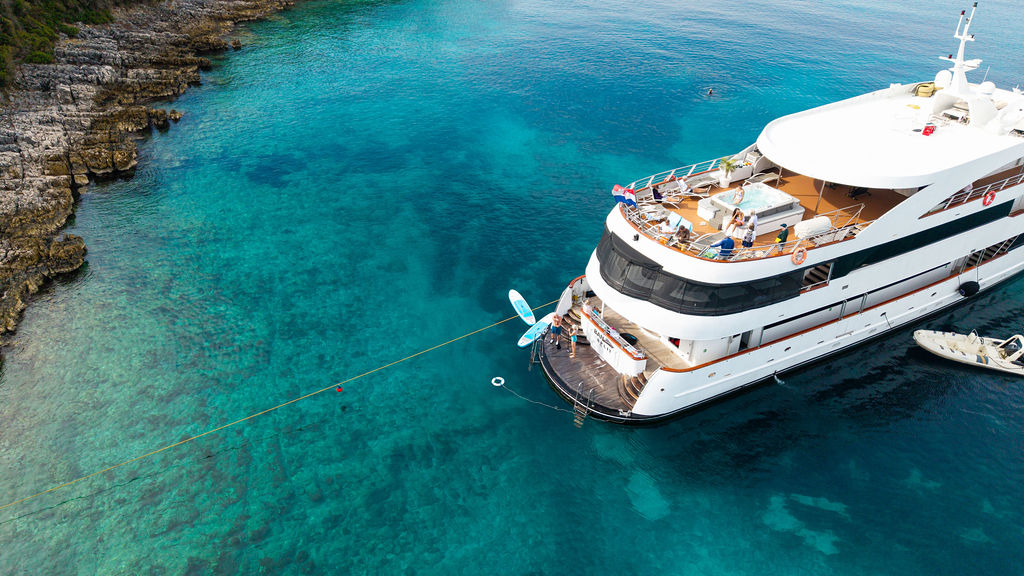
Our Croatian ships are smaller again: around 46 to 51 metres long, with 18 to 20 cabins and just 36 guests, looked after by a crew of eight or nine. Embarkation takes minutes, you know your way around by the first evening, and the crew soon knows how you take your coffee. The small size also lets the ship use island harbours, often a short walk from the old town, rather than large cruise terminals. Our fleet page has the details for each ship.
Cabins: Check the Window, Not Just the Deck
On any cruise, the cabin you book shapes your week more than the brochure suggests. On many river ships, the cheapest cabins are on the lowest deck, close to the waterline, with a small window set high in the wall. Newer river ships often have French balconies or full-height windows on the upper decks.
Our ships follow a similar pattern: lower deck cabins with portholes, main deck cabins with proper windows, and upper deck cabins with the best views, some with a balcony. The difference is what’s outside the window: islands, harbours and open sea, rather than a riverbank. Every cabin has air conditioning and its own shower and toilet, and our guide to cabin types explains what each deck is really like.
Sightseeing: Why Group Size Matters
A river cruise packs in a lot of sightseeing. Most days bring a new town and an organised excursion, and with up to about 190 guests on board, those excursions often run in several groups at once. It’s an efficient way to see a lot of Central Europe in a week.
With 36 guests, sightseeing feels very different. On our Adriatic Discovery cruise, the guided walks in Šibenik, Hvar, Korčula and Dubrovnik are led by local guides, with audio headsets so you can hear every word in narrow streets. Afterwards, the rest of the day is yours to explore at your own pace.
Food: Dinner in a Different Harbour Every Night
River ships usually have one main restaurant, sometimes with a more casual option. Breakfast and lunch are often buffets, and dinner is the main sit-down meal of the day, usually on board.
On our cruises, breakfast is served every day, along with six three-course lunches, a welcome dinner and the Captain’s Dinner. The other five evenings are spent ashore, in a different harbour town each night. That’s on purpose: choosing a konoba in Korčula or a waterfront table in Hvar is one of the best parts of the week.
A Day on Board: Riverbanks, or Swim Stops and Islands?
On a river cruise, the scenery is close on both sides while you sail, and days are built around time on land. It’s comfortable and easy, with no need to think about the weather on the water.
On a small coastal ship, the sailing itself is part of the holiday. A typical day on our cruises starts with an early sail, then a swim stop in a quiet bay, lunch on board and an afternoon in the next town, where the ship stays overnight. Swimming straight off the ship in clear Adriatic water is something no river can offer.
Water Levels and Wind: What Can Change Your Plans
Every cruise depends on nature; it’s just a different part of it. On rivers, the risk is water levels. When the water is too low, ships can’t sail some stretches safely, and when it’s too high, they can’t pass under bridges. In summer 2026, record low water on the Rhine and the Danube led to ship swaps, bus transfers and some cancellations across several river cruise lines.
On the coast, the risk is wind and waves, and it usually affects part of a day rather than the whole trip: a different bay for the swim stop, another berth, or a missed visit to the Blue Cave on Biševo. The captain can adjust the route when that’s needed for your safety and comfort.
What About Seasickness?
River water is flat, so on a river cruise you’ll barely feel the ship move. On the Croatian coast, our routes spend most of their time among the islands, which shelter them from the open sea. Sailing happens during the day and every night is spent in port, so you sleep with the ship moored. You may feel some motion when the wind picks up, but for most guests it isn’t an issue.
If you know you’re prone to motion sickness, book a lower or main deck cabin near the middle of the ship and spend sailing time on deck looking at the horizon. Our seasickness guide covers what helps and what the evidence says.
So, Which Is Best for You?
If you want islands, old harbour towns, swimming straight off the ship and evenings ashore with just 36 other guests, choose a small-ship coastal cruise. If you’d rather see cities, castles and vineyards along the great rivers of Central Europe, a river cruise is a lovely way to do it. And if what you really want is a big ship with pools, shows and plenty of choice on board, a large ocean cruise is the better fit.
One last thing: if you enjoyed a river cruise, a small-ship coastal cruise is the natural next step. You keep the small ship, the easy pace and the time ashore, and add the sea, the islands and a swim every day. Read why travellers choose a small ship and our guide to choosing a Croatia cruise, or browse our Croatia cruises for current routes and dates.
FAQ: River Cruising vs Coastal Cruising
What is the difference between river cruising and coastal cruising?
A river cruise follows a river inland, with land on both sides and calm water. A coastal cruise follows a coastline at sea, with islands, open views and, on a small ship, swim stops in bays along the way.
Which is better for a first cruise?
Both are easy first cruises. A small-ship coastal cruise suits people who want islands, swimming and evenings in harbour towns with only 36 guests on board. A river cruise suits people who mainly want cities and culture.
Do you get seasick on a river cruise?
Very rarely, because river water is calm. On a small-ship coastal cruise in Croatia, routes are largely sheltered by islands and nights are spent in port, so most guests are fine too, especially in a lower or main deck cabin.
Can you swim on a river cruise?
Not from the ship. Some river ships have a small pool on the sundeck, but swimming in the river isn’t part of the programme. On a small-ship coastal cruise, swim stops in bays are planned when conditions allow.
How many passengers are on a river cruise ship?
Many European river ships carry up to about 190 guests. Small coastal ships can be much smaller: ours in Croatia carry 36.
What happens on a river cruise when water levels are low?
Depending on the river and the cruise line, ships may be swapped, guests may be taken by bus between stretches of river, embarkation points may move or, in some cases, cruises may be cancelled.
Is a small-ship coastal cruise more like a river cruise or an ocean cruise?
It combines the best parts of both. In size and atmosphere, it’s closer to a river cruise, and even more intimate. In what you do each day, with sailing between islands, swim stops and harbour evenings, it’s a sea holiday.