
Isn’t a cruise just a floating hotel?” “Will I be stuck with thousands of other people?” “What do you actually do all day?”
Those are fair questions, and if your picture of a cruise comes from the big ocean liners, the answers might put you off. But a small-ship cruise in Croatia is not a scaled-down version of a mega-ship holiday. It’s a different way of travelling. The ship is your base for the week, while the coast stays the main event: island towns, swim stops in quiet bays, evenings in the harbour and a new view most mornings.
It won’t suit everyone, and we’d rather tell you that now than after you’ve booked. But if you want to see a long stretch of the Dalmatian coast without packing your suitcase every other day, here’s why it works so well.
First, What Kind of Ship Are We Talking About?
Our Croatian fleet is made up of small motor ships, each around 46 to 51 metres long, with 18 cabins, 36 guests and a crew of eight. A large ocean liner, by comparison, can carry thousands of passengers.
That difference in size changes almost everything about the trip, from where the ship can moor to how you spend your day. Here’s how the two compare:
| Small ship (Zantium) | Large cruise liner | |
| Guests on board | 36 | Often several thousand |
| Where you moor | Smaller harbours, often a short walk from the old town | Large cruise terminals or at anchor, sometimes a bus or tender ride from the centre |
| Between ports | Island channels, with swim stops in bays when conditions allow | Longer passages, sometimes whole days at sea |
| Evenings | In port, with most dinners in local restaurants | On board: shows, bars, casinos |
| On board | Sundeck, restaurant, bar and air-conditioned cabins | Pools, theatres, shops and kids’ clubs |
| Best for | Seeing several towns and islands at an easy pace | Plenty of onboard facilities and entertainment |
Unpack Once, Wake Up Somewhere New
The simplest advantage is also one of the most valuable: you unpack once. Your cabin stays the same while the route moves from port to port. Plan the same week on land and you could be looking at four or five hotels, repeated check-ins, road transfers and ferry tickets, especially if you want to combine mainland cities like Split and Dubrovnik with several islands.
A cruise takes most of that transport work off your hands. You still decide how to spend your time ashore, but the ship becomes a fixed base rather than one more place you have to get to. If you’re adding a few days before or after the cruise, our comparison of Split and Dubrovnik will help you choose where to spend them, and our Split guide covers what’s worth seeing in town.
No More Than 36 Guests: Sociable, Never Crowded
With 36 guests on board, embarkation is quick, everyone finds their way around the ship on the first day and faces become familiar fast. By the second evening, most guests know each other’s names, and plenty of them end up sharing a table ashore. The atmosphere is sociable without anyone organising entertainment every hour.
A small group doesn’t mean you have to spend the whole week together. There’s still time to read on the sundeck, explore a town on your own or join others for a drink. What you won’t feel is anonymous among thousands of passengers.
Closer to the Coast, Closer to the Old Towns
Small ships fit the scale of the Croatian coast. They can use harbours and anchorages the largest liners can’t, which often puts you right on the waterfront, a short walk from the historic centre. The exact berth always depends on the port authority, the weather and daily operations, so we never promise a specific spot. Hvar is a good example: harbour space there is limited, so on some sailings we moor in Stari Grad instead and arrange a transfer to Hvar town.
The view matters too. Instead of long stretches across open sea, the route follows a coast full of islands, channels and headlands. Sailing time becomes part of the holiday, not just the distance between two stops.
Swim Stops Instead of Sea Days
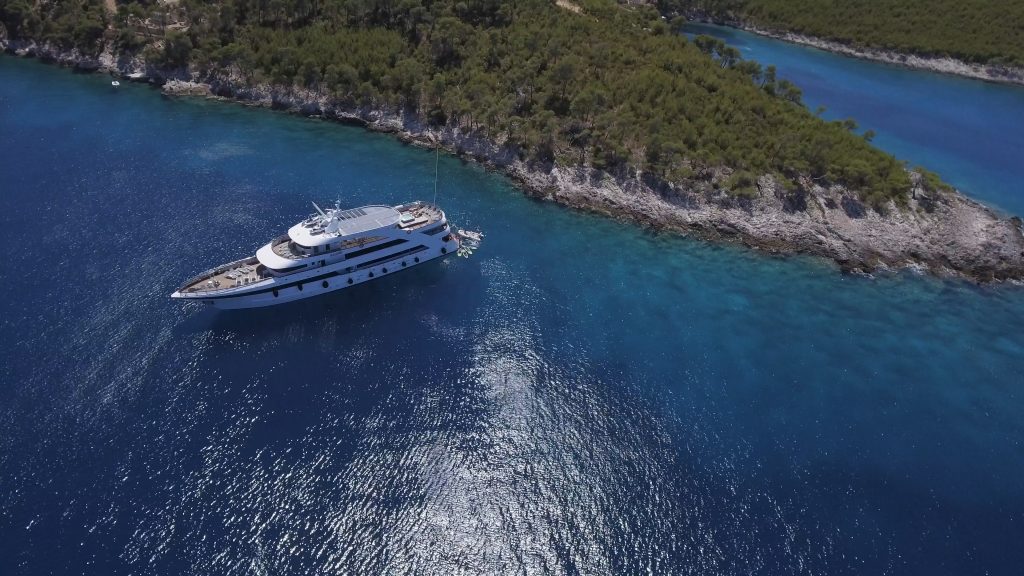
On several days of the week, the route includes a swim stop between ports, when the weather, the sea and the sailing schedule allow. The crew picks a suitable bay on the day, so the exact spot can change. That’s more honest, and usually more enjoyable, than promising one particular cove whatever the conditions. For some of the places we like best, see our guide to the best places to swim in Croatia.
The sea is right there, but always follow the crew’s instructions on when and where to get in and how to use the ladder. A planned swim stop is part of the route, not an invitation to jump in whenever the ship stops.
A Simple Day on Board, and Dinner Ashore
A small ship doesn’t try to be a resort. A typical day goes something like this: breakfast on board, a morning sail, a swim stop when conditions allow, lunch on board, then the afternoon and evening in port.
Evenings are spent ashore rather than in front of a stage show. On our standard Croatia cruise, breakfast every day, six lunches, a welcome dinner and the Captain’s Dinner are included, while the other five dinners are in local restaurants and paid separately. That’s on purpose: a different harbour-front konoba every evening is one of the best parts of the week.
Inclusions vary by route and departure, so always check the price breakdown for yours. Our Croatia Cruise Cost 2027 guide lists exactly what’s in the fare and what isn’t.
What You Won’t Find on Board
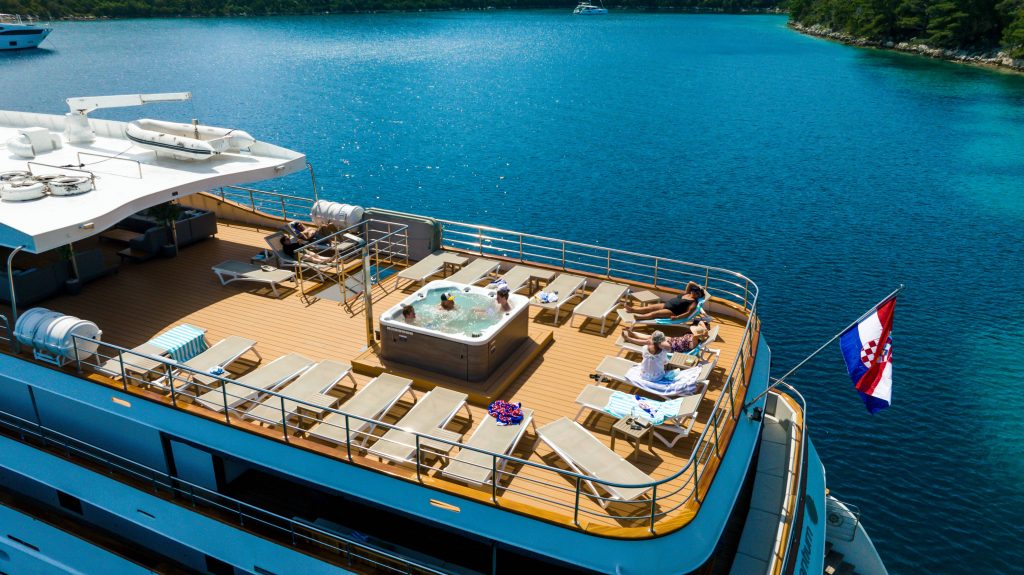
There are no casinos, water parks, shopping promenades or big entertainment programmes, and no kids’ clubs like those on family-focused liners. Some of our ships have a small pool or a jacuzzi on deck, but the Adriatic is the real swimming pool here. If you want lots of onboard facilities, a larger ship will suit you better, and that’s fine. If you’d rather have a quiet base and more time on the coast, a small ship is the better fit.
So, Is a Small-Ship Cruise Right for You?
If you want to see several towns and islands without moving your luggage, like being close to the water and don’t mind a shared daily rhythm, book a small-ship cruise. If you’re travelling as a group or a family and want to spend the week together rather than splitting up between onboard activities, it works just as well. And if you need round-the-clock entertainment, extensive step-free access or complete anonymity, a large ship is probably the better choice.
One last thing: ship layouts vary, and moving between decks means using stairs. If you have mobility or accessibility needs, talk to us about the exact ship before you book. Our guide to cabin types explains which cabins mean the fewest stairs.
In the end, a small-ship cruise is about the coast, not the ship. Browse our Croatia cruises for current routes and departure dates, compare the ships in our fleet, or contact our team if you’d like to check whether this way of travelling suits your trip.
FAQ: Small-Ship Cruising in Croatia
How is a small-ship cruise different from a large cruise liner?
Mainly in scale, facilities and pace. Our ships carry no more than 40 guests and focus on the coast and the ports, not on onboard entertainment. They can use smaller harbours closer to the old towns and stop for a swim between ports.
How many guests travel on a Zantium ship?
Between 36 and 40, depending on the ship, in 18 to 20 cabins. You’ll find the exact figures for each ship on our fleet page.
Are swim stops guaranteed every day?
No. Swim stops are planned when the itinerary, weather, sea state and operating conditions allow. The captain and crew make the final call, so the location or timing can change.
Are excursions and dinners included?
Partly. On our standard Croatia cruise, breakfast, six lunches, a welcome dinner, the Captain’s Dinner and guided walking tours in Šibenik, Hvar, Korčula and Dubrovnik are included. The other five dinners, bar drinks and the port and residence tax are paid separately, so check the price breakdown for your departure.
Is small-ship cruising suitable for first-time cruisers?
Yes, for most people. The ship is easy to find your way around and the daily routine is simple. First-timers should still think about cabin size, stairs, motion and the simpler onboard facilities before booking.
Will I get seasick on a small ship?
You may feel the motion more than on a large liner, especially when the wind picks up. Much of the route runs between islands rather than across open sea, but if you’re prone to motion sickness, read our seasickness guide and choose your cabin with care.
Can families join a small-ship cruise?
Yes, depending on the ship, the cabin arrangement and the children’s ages. There are no kids’ clubs or water parks, so it suits families who enjoy swimming, sightseeing and spending time together.