
“Which route should I pick?” “Does it matter which month I go?” “Why is the same cruise €500 cheaper on one date than another?”
Search for Croatia cruises for five minutes and the options start to blur together. The same island names come up again and again, every ship seems to have a sunny deck, and almost every itinerary promises time for a swim. It’s tempting to just pick the cheapest fare or whichever ship looks best in the photos.
But that’s rarely what decides whether the week feels right once you’re on board. Knowing how to choose a Croatia cruise comes down to a handful of questions: which part of the coast, which month, how the days are paced and what the fare actually includes. The useful differences are usually hidden in the day-by-day itinerary, not on the brochure cover. Here’s what we’d look at first.
First, Decide Which Part of the Coast You Want to See
Croatia’s coast is long enough to hold several very different cruises. In the north, Istria and the Kvarner Gulf have islands like Cres and Krk. Further south, Dalmatia is home to most of the classic island-hopping routes, around Split, Hvar, Vis, Korčula, Mljet and Dubrovnik. Those are different trips, not just different versions of the same route.
So start with the map, not the ship. If Dubrovnik and the Dalmatian islands are already on your list, look at routes that stay in that part of the coast. If you’re set on Istria or Kvarner, you’ll need a northern itinerary instead. All our own Croatia cruises sail in Dalmatia.
Our 2027 Adriatic Discovery route is a good example of how a Dalmatian cruise works. It runs for eight days between Šibenik/Split and Dubrovnik, with overnights in Šibenik, Vis, Hvar, Korčula, Pomena on Mljet, Slano and Dubrovnik. The distances are short enough to combine island stops with time in historic towns, instead of spending long days just getting from one end of the coast to the other.
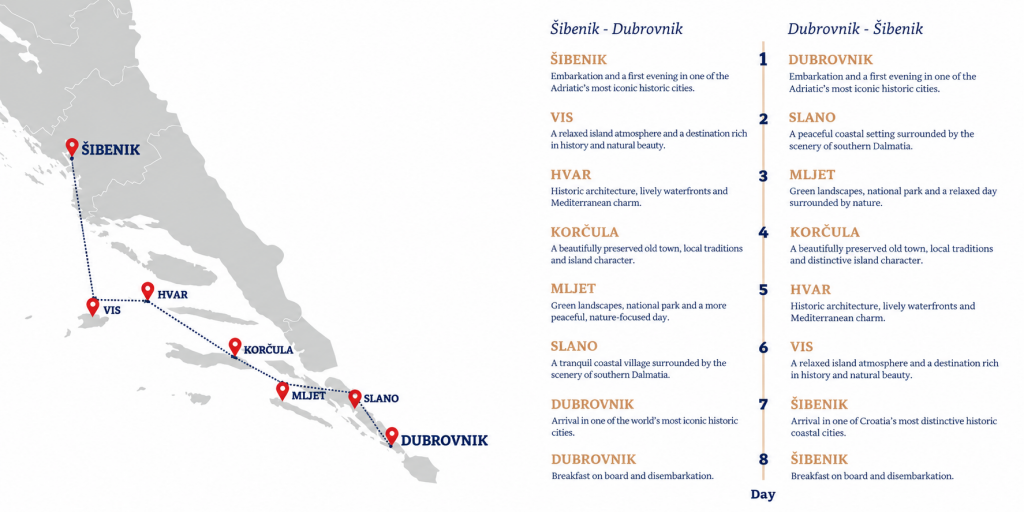
The Port List Is Only the Beginning
Two cruises can show almost the same names on the map and still feel completely different. What time does the ship arrive? Do you stay overnight in port? Is there a guided walk, or is the afternoon free? Do you leave town just after breakfast? These details tell you far more about a trip than the number of destinations in the headline.
On a small ship, sailing is part of the day, not something that happens while you sleep. On Adriatic Discovery, a typical day starts with an early sail, then a swim stop and lunch on board on the way, and an afternoon in the next town, where the ship stays overnight. That rhythm suits people who enjoy being on the water as much as sightseeing. If you’d rather have full days ashore, look closely at arrival and departure times instead of assuming every stop means a whole day in town.
Coastal travel also comes with some built-in uncertainty. Weather and sea conditions affect swim stops and boat trips, and harbour space can change where the ship moors. The Blue Cave on Biševo, for example, is reached by small boat through an entrance approximately 5 feet high, so bad weather and high waves can close it. And because Hvar harbour has limited room, we sometimes moor in Stari Grad instead and arrange a transfer to Hvar town. On a trip that depends on the sea, that kind of flexibility is normal.
One-Way or Round Trip? Check Where the Ship Actually Is
A one-way cruise fits neatly into a longer trip around Croatia. Start near Split and finish in Dubrovnik, or the other way round, and you can add a few hotel nights at either end without going back to the same city. It also feels more like a journey, with the coast unfolding in one direction. If you’re adding time on land, our Split guide and our comparison of Split and Dubrovnik will help you decide where to spend it.
A round trip has a different advantage: you arrive and leave from the same city, which can make flights simpler. Neither is automatically better. What matters is checking the exact embarkation and disembarkation points before you book flights, because a route named after a big city doesn’t always start there.
That’s exactly the case on our southbound Adriatic Discovery. You meet the cruise manager at noon at the bus parking in front of Berth 18 in Split port, and a bus takes you to Šibenik, where the ship is waiting. If you fly into Split, the transfer takes you straight from the airport to Šibenik. At the other end, the ship docks at Gruž harbour in Dubrovnik, with a transfer to Dubrovnik airport on the last morning. The same route also runs northbound, from Dubrovnik to Split.
The Month Changes More Than the Weather
No country in the EU packs more of its tourism into the summer than Croatia. According to Eurostat, 54.5% of all tourist accommodation nights in Croatia in 2025 were spent in July and August, the highest share in the EU.
That doesn’t make July or August a bad choice. They’re the months for the full summer atmosphere and the warmest sea, as long as you’re happy to travel at the busiest time. June and September are still well within the main coastal season without the biggest crowds. And May and October suit people who’d rather walk around towns than spend every hour in the water. Here’s how the months compare:
| Month | What to expect | Best for |
| May | Sea around 64°F, lots of sunshine (about 270 hours in Split), quieter towns | Sightseeing on foot, if a cool swim doesn’t put you off |
| June | Early summer, before the July and August peak | A summer feel without the biggest crowds |
| July and August | Warmest sea (about 77°F in August in August), many days reaching 86°F, the busiest towns and harbors | Swimming and the full summer atmosphere |
| September | Still in the main season, after the summer peak | Warm days with fewer people |
| October | Sea around 70°F, warmer than in May, but more rain and more changeable weather | Quieter harbours and lower fares |
The price changes with the season too. Our 2027 Adriatic Discovery departures run every Saturday from 1 May to 16 October, from €1,890 per person on the first and last sailings up to €2,390 on other dates. For the full numbers behind each month, see our guide to Adriatic weather. There’s no single best month, only the month that matches what you want from the trip.
Small Ship or Big Ship? Two Very Different Holidays
“Croatia cruise” covers very different holidays. On a large ship, Croatia is often one or two stops on a wider Mediterranean itinerary. A small coastal ship spends the whole week here, with short sailing legs, swim stops and evenings ashore.
That difference matters before you start comparing facilities. A small ship usually has one restaurant rather than a choice of venues, and far less onboard entertainment. In return, the ship becomes part of the route rather than the destination itself.
To put it in perspective, our Azzurro has 18 cabins and 36 berths, and none of our Croatian ships takes more than 40 guests. That’s a completely different social setting from a ship carrying thousands of passengers. It feels more personal, but don’t expect the venues, kids’ facilities or shows of a resort-style liner. Our article on why travel by cruise ship explains the difference in more detail.
Cabin Choice: Look Past the Deck Name
Lower deck, main deck, upper deck, balcony: the labels help, but they’re not enough on their own. Look at the actual deck plan. Check where the stairs are, how the beds are arranged, what kind of window the cabin has and how close it is to shared areas. Two cabins in the same price category can feel quite different after a week. Our guide to cabin types explains what each deck is really like.
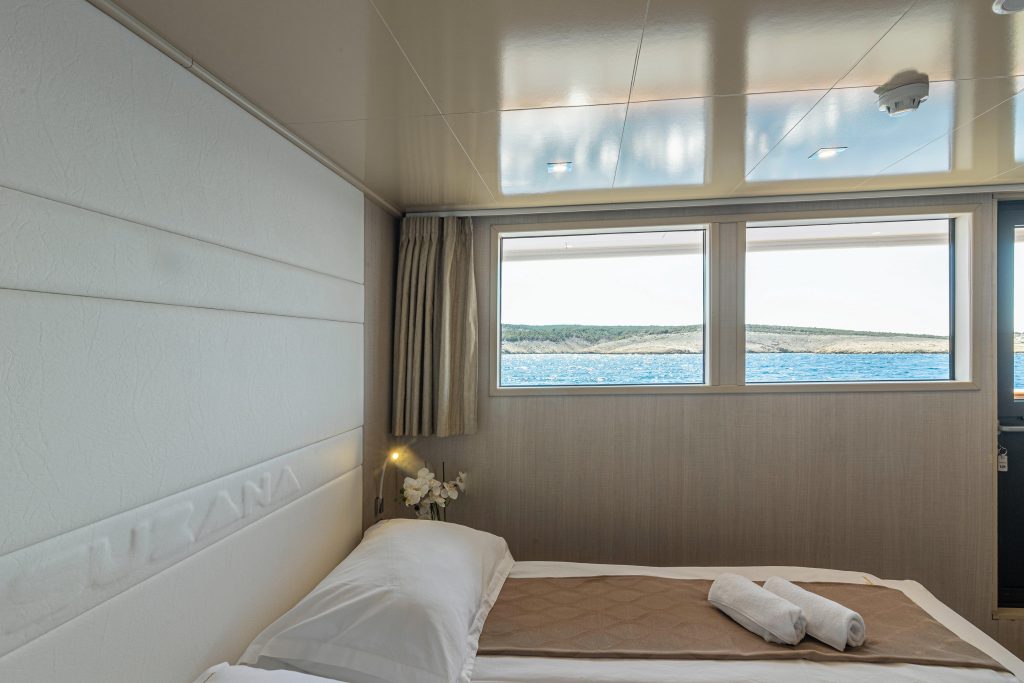
Mobility is another reason to look beyond the photos. Small ships have several decks connected by stairs, and layouts vary from ship to ship. If stairs are hard for you, ask us about the route from your cabin to the dining area and the outside decks before you confirm.
The same goes for motion. A small ship can move when the sea picks up, and no cabin can guarantee a motion-free week. If you’re prone to seasickness, ask us which ship and cabin position suit you best, read our seasickness guide and talk to a doctor or pharmacist about prevention.
Compare What’s Included, Not Just the Price
This is where quick price comparisons go wrong. One fare may include airport transfers, several guided tours and most meals, while another leaves more of that to you. Port taxes, drinks, national park tickets, optional excursions and tips are also handled differently from one company to another.
So before you decide one cruise is cheaper, put the inclusion lists side by side for the exact departure. Here’s what our 2027 Adriatic Discovery fare covers, as an example of what to check:
| What to check | Adriatic Discovery 2027 |
| Transfers | Included on the first and last day: Split airport or Split port to Šibenik, and Gruž harbour to Dubrovnik airport |
| Meals | Breakfast every day, six three-course lunches, a welcome dinner and the Captain’s Dinner. The other five dinners are ashore and paid separately. |
| Guided tours | Walking tours of Šibenik, Hvar, Korčula and Dubrovnik with English-speaking local guides |
| Tastings and entrance fees | Ston oyster tasting and Blue Cave entrance included. Mljet National Park is optional and paid separately. |
| Drinks | Drinking water, plus coffee or tea at breakfast. Other drinks are paid separately. |
| Port and residence tax | €85 per person per week, paid in cash on board |
| Tips | Not included and optional |
| Wi-Fi | Free on board |
Always check the current list for your departure rather than an older blog post or last year’s brochure. Programs change, and something included one season isn’t automatically included the next. For a full breakdown of prices and extra costs, see our Croatia Cruise Cost 2027 guide.
How Much Structure Do You Want in Your Day?
Some people like opening the cabin door knowing the day is already planned. Others want the ship to get them to the next island and then leave them alone for a few hours. Croatia cruises cover both ends of that spectrum.
Read the itinerary for clues. A guided walk followed by a free evening gives you some context without taking over the day. A program packed with excursions suits people who like more structure, while a route with long swim stops and fewer organized visits feels looser. Adriatic Discovery sits in the middle: four guided town walks, an oyster tasting and the Blue Cave, with plenty of free afternoons and evenings in between.
So, How Do You Choose?
Imagine waking up on the third or fourth morning. Would you rather be sailing before breakfast, stopping for a swim and reaching an island after lunch? Or already moored in port with the whole day ahead of you? Do you want dinner on board, or do you look forward to finding somewhere new ashore each evening? Those questions quickly separate itineraries that look almost identical on paper.
If you want islands, swim stops and short sailing days, book a small-ship cruise in Dalmatia. If you want long days ashore and lots of onboard facilities, a larger ship may suit you better. And if you’re torn between dates, go for late May, June or September for a good balance between weather and crowds.
The ship, the cabin and the price all matter, but the best clue is usually the pace hidden between the headline destinations. Once that feels right, the rest of the decision gets much easier. Browse our Croatia cruises by sailing date, or compare the ships in our fleet.
FAQ: Choosing a Croatia Cruise
Which part of Croatia should I choose for a cruise?
Start with the places you most want to see. Routes with Split, Hvar, Vis, Korčula, Mljet and Dubrovnik are in Dalmatia, while cruises around Istria and Kvarner cover the northern Adriatic, with a different mix of islands and towns.
Is July or August the best time for a Croatia cruise?
Not necessarily. July and August are the busiest months, with 54.5% of Croatia’s tourist nights in 2025. They’re great for warm water and summer atmosphere, while June and September are quieter, and May and October suit travelers who care more about sightseeing.
When does the Croatia cruise season start and end?
Small-ship cruises in Croatia generally run from spring to autumn. Our 2027 Adriatic Discovery departures run every Saturday from 1 May to 16 October.
Is a one-way cruise better than a round trip?
Neither is better; they solve different problems. A one-way cruise links two parts of the coast and works well with hotel stays before or after, while a round trip uses the same city at both ends, which can make flights simpler. Either way, check the exact embarkation port, not just the city in the route name.
What should I compare besides the cruise price?
Transfers, meals, guided tours, entrance fees, port and residence tax, drinks, optional excursions and tips. Compare the total cost for the exact departure, not just the starting fare.
Can a Croatia cruise itinerary change?
Yes. Weather, sea conditions and harbour space can affect swim stops, excursions, berths and port calls. On our cruises, the captain may change the itinerary when that’s needed for your safety and comfort.
What if I am worried about seasickness?
Small ships can move noticeably when the sea picks up. Ask us which ship and cabin position suit you best, read our seasickness guide and talk to a doctor or pharmacist about prevention before you travel.